
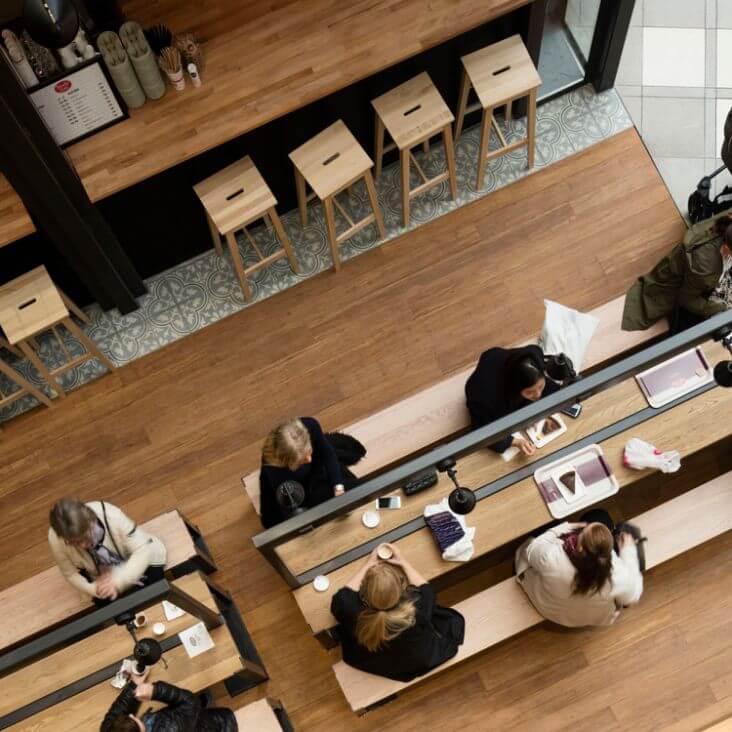
Commercial spaces are tough on materials. Floors deal with constant foot traffic, rolling furniture, cleaning machines, spills, temperature changes, and long operating hours every single day.
That is exactly why engineered bamboo has become such a popular option in modern commercial design.
Today’s high-density bamboo products are built to handle busy environments while still looking clean, modern, and high-end.
At Bamboo Design Canada, our Densified™ bamboo flooring is specifically engineered for high-performance residential and commercial applications. With Janka hardness ratings above 3,500 lbf, our flooring delivers impressive strength, and impact resistance. Oh and let’s not forget the long-term dimensional stability without sacrificing aesthetics!
Commercial Spaces Need Flooring That Can Handle Real Life
Residential flooring has it easy compared to commercial interiors.
Commercial spaces deal with:
- Thousands of footsteps daily
- Rolling office chairs
- Moving furniture
- Heavy cleaning routines
- Moisture fluctuations
- Constant wear and tear
- Long business hours
Low-quality flooring starts showing problems pretty quickly in these environments.
You’ll often see:
- Gaps forming between planks
- Warping or buckling
- Surface dents
- Edge lifting
- Scratches and wear patterns
- Uneven flooring over time
In large commercial spaces, even small amounts of expansion and contraction become very noticeable.
That’s where dimensional stability becomes incredibly important.
What Is Dimensional Stability Anyway?
Dimensional stability sounds technical, but the idea is simple.
It refers to how well a material holds its original shape when the environment around it changes. Natural wood and bamboo react to humidity levels. When moisture levels rise or drop, materials naturally expand and contract.
Too much movement can lead to:
- Cracks
- Cupping
- Gaps between boards
- Uneven surfaces
- Structural stress over time
Engineered bamboo is designed specifically to reduce these problems.
Why Engineered Bamboo Stays More Stable
Modern manufacturing makes a huge difference.
Engineered bamboo becomes more stable because the fibers are:
- Compressed under intense pressure
- Dried to controlled moisture levels
- Stabilized using advanced resin systems
- Densified to reduce internal air gaps
The end result is a much denser and more consistent material. Which handles moisture changes far better than many traditional flooring products. That’s a big advantage in commercial environments where flooring covers large open spaces.
How Engineered Bamboo Gets Its Strength
Raw bamboo is naturally strong, but engineered bamboo takes things to another level.
The Manufacturing Process Makes the Difference
The process starts by:
- Splitting bamboo into strips or fibers
- Removing softer inner material
- Drying the bamboo carefully
- Compressing fibers under massive pressure
- Bonding everything together with industrial-grade adhesives
This transforms bamboo into a dense composite material built for durability and long-term stability.
Strand Woven Bamboo Is Incredibly Dense
One of the strongest types of engineered bamboo is strand woven bamboo.
Instead of using flat strips, manufacturers compress shredded bamboo fibers together under extreme hydraulic pressure.
This dramatically increases:
- Density
- Hardness
- Impact resistance
- Wear resistance
- Structural consistency
For comparison:
- Red oak averages around 1,290 lbf
- White oak averages around 1,360 lbf
- High-density bamboo can exceed 3,500 lbf
That extra hardness matters a lot in busy commercial spaces. It helps flooring resist dents, scratches, and wear patterns far longer.
Where Bamboo Performs Best in Commercial Spaces
Engineered bamboo is no longer limited to eco-friendly residential interiors.
Today, it’s widely used across commercial projects because it balances durability with modern design.
Hotels and Hospitality Spaces
Hotels need flooring that still looks great after years of heavy use.
Engineered bamboo works beautifully in:
- Hotel lobbies
- Hallways
- Guest suites
- Lounge areas
- Reception spaces
Its dense surface helps reduce visible wear while creating a warm and upscale atmosphere.
Retail Stores and Showrooms
Retail spaces are brutal on flooring.
Customers, shopping carts, cleaning equipment, and moving displays constantly put pressure on surfaces.
High-density bamboo flooring performs especially well in:
- Retail boutiques
- Shopping centers
- Product showrooms
- Commercial galleries
The durability helps businesses maintain a polished and professional look for much longer.
Offices and Corporate Interiors
Modern offices want more than just durability.
They also want materials that feel warm, natural, and sustainable.
Engineered bamboo fits perfectly into:
- Open-plan offices
- Conference rooms
- Reception areas
- Executive spaces
- Co-working environments
Its dimensional stability is especially useful in large office layouts where flooring movement becomes easy to notice.
Restaurants and Cafés
Restaurants need flooring that can survive constant activity.
Commercial bamboo flooring offers:
- Strong wear resistance
- Better long-term stability
- Easier maintenance
- Contemporary aesthetics
It’s durable enough for busy hospitality environments while still feeling inviting and stylish.
Bamboo Is Being Used Far Beyond Flooring
Flooring is just the beginning.
Engineered bamboo now appears throughout modern commercial interiors.
Popular applications include:
- Wall panels
- Ceiling systems
- Acoustic panels
- Stair treads
- Reception desks
- Decorative cladding
- Cabinetry
- Retail fixtures
- Architectural millwork
Its clean grain patterns and modern texture work beautifully in both minimalist and natural-inspired spaces.
Architects also love how versatile bamboo can be in custom commercial designs.
Moisture Resistance Makes a Big Difference
Commercial interiors constantly deal with changing moisture conditions.
Air conditioning systems, weather shifts, and cleaning routines all affect indoor humidity levels. High-quality engineered bamboo is manufactured to better handle those changes.
Features That Help Reduce Moisture Problems
Several manufacturing techniques improve stability, including:
- Fiber compression
- Resin stabilization
- Controlled moisture drying
- Thermal treatment processes
These methods help reduce:
- Swelling
- Shrinking
- Seasonal movement
- Moisture-related warping
Proper installation still matters, of course.
However, well-manufactured engineered bamboo generally performs far more consistently than many traditional solid wood materials in commercial environments.
| Commercial Application | Bamboo Application | Main Benefits |
|---|---|---|
| Offices | Flooring, Walls & Ceilings | Natural appearance, professional design and a comfortable atmosphere |
| Restaurants & Cafés | Flooring & Wall Applications | Warm natural look and versatile interior design |
| Retail Stores | Flooring & Wall Applications | Modern visual appeal, durability and flexible design options |
| Hotels & Hospitality | Flooring, Walls & Interior Features | Elegant natural finish and distinctive interior character |
| Gyms & Fitness Centers | Bamboo Flooring | Durable surface with a warm and natural appearance |
| Schools & Educational Facilities | Flooring & Wall Applications | Natural aesthetic and versatile interior design |
| Healthcare & Wellness | Bamboo Flooring & Wall Applications | Calm natural appearance and flexible commercial design |
Sustainability Is Another Major Advantage
Commercial projects today are paying much more attention to sustainability. Businesses want materials that are durable, attractive, and environmentally responsible. Engineered bamboo checks all three boxes.
Why Bamboo Is Considered Sustainable
Bamboo offers several environmental benefits:
- Rapid growth cycle
- Regeneration without replanting
- High carbon absorption
- Reduced pressure on hardwood forests
- Faster harvesting compared to traditional timber
Many commercial bamboo species mature within five to seven years, while hardwood trees often take decades.
Many engineered bamboo products also contribute toward:
- LEED projects
- FSC-certified sourcing
- Low VOC indoor air quality standards
- Green building initiatives
That balance of sustainability and performance is one reason bamboo continues gaining attention in commercial architecture.
Choosing the Right Bamboo Product Matters
It’s incredibly essential to understand that not all bamboo flooring performs the same way. Commercial durability depends heavily on manufacturing quality.
Lower-quality products may experience:
- Weak adhesive bonding
- Delamination
- Surface finish failure
- Inconsistent density
- Excessive movement over time
For commercial projects, it’s important to choose bamboo flooring designed specifically for high-traffic environments.
Look for products with:
- High-density construction
- Commercial-grade finish systems
- Stable engineered cores
- Proven hardness ratings
- Low VOC certifications
Professional installation also plays a huge role in long-term performance.
Proper acclimatization, moisture testing, and subfloor preparation all help maximize durability and dimensional stability.
Conclusion
Engineered bamboo has come a long way from being viewed as simply an eco-friendly alternative.
Today, it’s recognized as a serious high-performance material for modern commercial interiors.
Its combination of:
- Exceptional hardness
- Dimensional stability
- Moisture resistance
- Modern aesthetics
- Sustainable sourcing
makes it a smart long-term choice for commercial spaces.
From offices and hotels to airports and retail stores, engineered bamboo continues proving that durability, performance, and beautiful design can absolutely work together.

0 Comments