
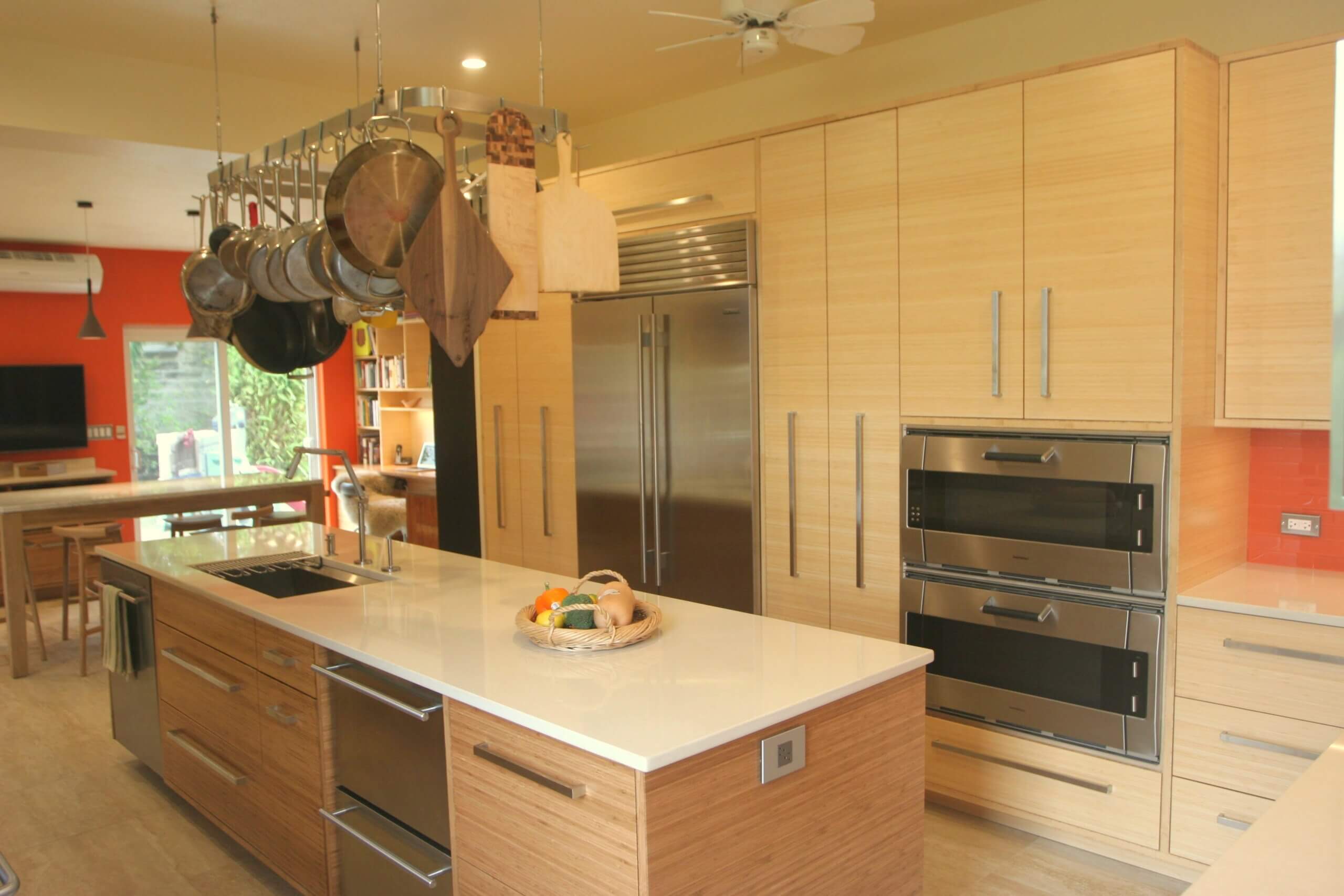
| Flooring Type | Moisture Resistance | Durability | Best For |
|---|---|---|---|
| Hardwood | Moderate | High | Warm, open-concept kitchens |
| Laminate | Low–Moderate | Moderate | Light-use kitchens |
| Porcelain / Ceramic Tile | Excellent | Very High | High-traffic kitchens |
| LVP / SPC | Excellent | High | Busy, spill-prone kitchens |
| Strand-Woven Bamboo | Moderate | Very High | Warm, durable kitchens |
Let’s stop pretending kitchens are neat, controlled spaces.
They’re not.
They’re where oil splatters mid-cooking, water drips from the sink, chairs scrape back and forth, and someone always drops something heavy at the worst possible time.
Your flooring doesn’t just sit there looking pretty. It takes hits, gets wet, heats up and cools down. Oh and in Canada, it also deals with dry winter air and humid summers on top of all that.
So yeah, kitchen flooring needs a different kind of toughness.
Best Flooring Options for Kitchens in Canada
Here are some of the best flooring options for kitchens in Canada.
Hardwood Flooring
Hardwood brings warmth and character to a kitchen.
It works well visually, especially in open layouts, but it requires attention. Kitchens introduce moisture, and wood reacts to that.
Small spills are manageable, but repeated exposure can lead to visible changes over time.
It’s a good option if you’re willing to maintain it properly.
Laminate Flooring
Laminate offers a clean look at a lower cost.
It handles scratches reasonably well and is easy to install, but moisture is its weak point. Over time, water exposure can cause swelling, especially at the edges.
It works better in kitchens with lighter use.
Porcelain or Ceramic Tile
Tile is built for tough environments.
It doesn’t absorb water, doesn’t react to heat, and doesn’t wear down easily. It’s one of the most durable options you can put in a kitchen.
The downside is comfort. It’s hard underfoot and can feel cold unless you have radiant heating.
Still, if durability is your priority, tile delivers.
Luxury Vinyl Plank (LVP / SPC)
This is the easiest recommendation for a reason.
It handles spills without stress, doesn’t react to humidity, and holds up well under daily use. You don’t have to think twice when something hits the floor or water sits for a bit.
However, here’s the part people don’t always talk about.
Even though it looks like wood, it doesn’t feel like it. Most SPC flooring is built over a limestone composite core, which is basically a stone-based layer. So underfoot, especially in colder months, it can feel… a bit cold and hard.
It’s also not the most environmentally friendly option. It’s a manufactured product, not a natural material, and it doesn’t really add long-term value to your home in the way hardwood or quality bamboo can.
Bamboo Flooring for Kitchens (Detailed Breakdown)
Bamboo in kitchens isn’t a yes or no decision. It’s how well you understand the material decision.
Because unlike vinyl or tile, bamboo reacts. To moisture, to air, to temperature, to how your kitchen is actually used. That’s exactly why it performs brilliantly in some homes and fails in others.
The Structural Difference (Why Bamboo Isn’t Just “Wood”)
Bamboo isn’t cut from a tree. It’s engineered. BamBüPly® is a high-performance bamboo plywood product that demonstrates how bamboo can be engineered into a strong, versatile material.
The raw material, typically Moso bamboo, is broken down and rebuilt into flooring. That process determines everything, density, strength, and how it behaves in a kitchen.
Traditional vertical and horizontal bamboo flooring is made by gluing together narrow strips of bamboo. That might sound solid, but it isn’t. This method actually creates more seams and a less dense structure compared to strand-woven bamboo. As a result, it behaves more like classic hardwood.
In a kitchen setting, that means it’s decent, but not the toughest option out there. With constant foot traffic, chair movement, and the occasional dropped item, it tends to show wear a bit faster, especially in busier kitchens.
Strand-woven bamboo is a completely different material. The fibers are shredded, saturated with resin, and compressed under extreme pressure. This process creates a very dense, compact structure with significantly higher durability.
That density is what gives it serious performance advantages in kitchens.
Impact Resistance (Because Kitchens Are Not Gentle)
Kitchens are full of impact moments.
A cast-iron pan slips. A jar falls. A chair leg hits harder than expected.
This is where strand-woven bamboo stands out.
With hardness levels often exceeding 3,000 to 5,000 lbf on the Janka scale, it’s significantly tougher than oak or maple. That translates to fewer dents, better resistance to heavy use, and a floor that doesn’t look worn too quickly.
Stability in Canadian Kitchens (This Is Where Engineered Matters)
Here’s the part that makes or breaks bamboo in Canada.
Indoor conditions change a lot.
Dry winter air pulls moisture out of the planks. Whereas, humid summers push it back in.
Solid strand-woven bamboo offers good stability. However, it needs to be installed correctly over a suitable subfloor and within proper humidity limits, which means:
- Less gapping in winter
- Less cupping in summer
- More predictable long-term performance
In kitchens, where heat and moisture fluctuate daily, this stability can be a big advantage.
Moisture Behavior (The Kitchen Reality Check)
Let’s be clear.
Bamboo is not waterproof. But it’s also not fragile. High-density strand-woven bamboo absorbs moisture more slowly than traditional wood. That gives you time to deal with spills before they become a problem.
In practical terms, everyday kitchen spills are manageable.
The risk comes from:
- Standing water
- Leaks under appliances
- Moisture reaching seams or subfloor
That’s when long-term damage and structural issues begin.
So the rule is simple: spills are fine, however neglect is not.
Installation Matters More Than You Think
Even the best bamboo flooring can fail with poor installation.
Kitchens require precision because small mistakes show up quickly.
The subfloor needs to be flat and dry. Moreover, expansion gaps must be left along the perimeter and around pipes or other fixed objects to allow natural movement.
Without these, you risk:
- Buckling
- Gapping
- Uneven wear
Bamboo only needs to be treated right, and it will deliver!
Cost vs Long-Term Value
Bamboo sits in a balanced price range.
Not cheap, but not excessive either.
- Entry-level options are more affordable
- High-density strand-woven products cost more
- Installation quality affects total cost significantly
What you’re really paying for is performance.
Cheaper bamboo often means lower density, weaker finishes, and shorter lifespan.
Higher-quality bamboo holds up better over time, especially in kitchens.
Conclusion
Kitchens are messy and unpredictable. Your flooring should be ready for all of it.
Vinyl shrugs things off. Tile doesn’t care what you throw at it. However, bamboo? It shows up strong, but expects a little respect.
Pick based on how you actually live.
If your kitchen is chaotic, go waterproof and relax. Whereas if you want something warmer and still very tough, good-quality strand-woven bamboo can absolutely work. Just don’t ignore it.
At the end of the day, the best kitchen floor isn’t the prettiest one. It’s the one that survives your cooking habits!

0 Comments